


Is Tear Trough Filler Safe? The Risks to Know First

by Healthwire
SHARES

Tear trough filler softens the hollows and shadows that form between the lower eyelid and the cheek. In trained hands it is generally considered low risk, but the under-eye is one of the most delicate areas of the face to inject. Knowing why helps you choose the right practitioner and ask the right questions.
Why the under-eye area is different
The skin beneath the eye is extremely thin, in places less than half a millimetre according to Dr Hass Clinic in London. It sits over a dense network of blood vessels and lymphatic channels, with very little fat to cushion them, and it lies close to the eye itself.
That leaves little margin for error. Filler placed too close to the surface can show through the skin, and filler placed in the wrong layer can affect blood flow or drainage.
Tear trough filler softens the hollows and shadows that form between the lower eyelid and the cheek. In trained hands it is generally considered low risk, but the under-eye is one of the most delicate areas of the face to inject. Knowing why helps you choose the right practitioner and ask the right questions.
Common side effects
Most side effects are mild and short-lived:
- Bruising and swelling, usually settling within a week
- Tenderness where the filler was placed
- Small lumps or unevenness, which often settle on their own
Rare but serious risks
- Vascular occlusion: filler blocking a blood vessel and reducing blood supply to the skin. It is rare, but it needs urgent treatment.
- The Tyndall effect: a bluish tint when filler sits too close to the surface.
- Overfilling: puffiness or an unnatural contour, usually from too much product.
- Problems affecting the eye itself are extremely rare, and they are the main reason this area should only be treated by medically trained injectors.
Why reversibility matters
Most practitioners use hyaluronic acid filler here because it can be dissolved with an enzyme called hyaluronidase if something goes wrong. Permanent fillers are strongly discouraged under the eye, because complications are far harder to correct.
Technique matters too. Many practitioners prefer a blunt-tipped cannula for most tear trough work, as it is less likely than a sharp needle to puncture a vessel.
"When performed by a trained medical professional, tear trough filler is far safer than many expect," says Dr Hasaneen Al Janabi, a GMC-registered doctor and member of the Royal College of Surgeons. "Most complications occur when treatments are carried out by non-medical injectors, with insufficient anatomical knowledge, inappropriate products or overly aggressive techniques."
Patients booking tear trough filler with Dr Hasaneen Al Janabi at his Mayfair clinic are assessed for skin thickness, previous surgery and the shape of the under-eye before anything is planned.
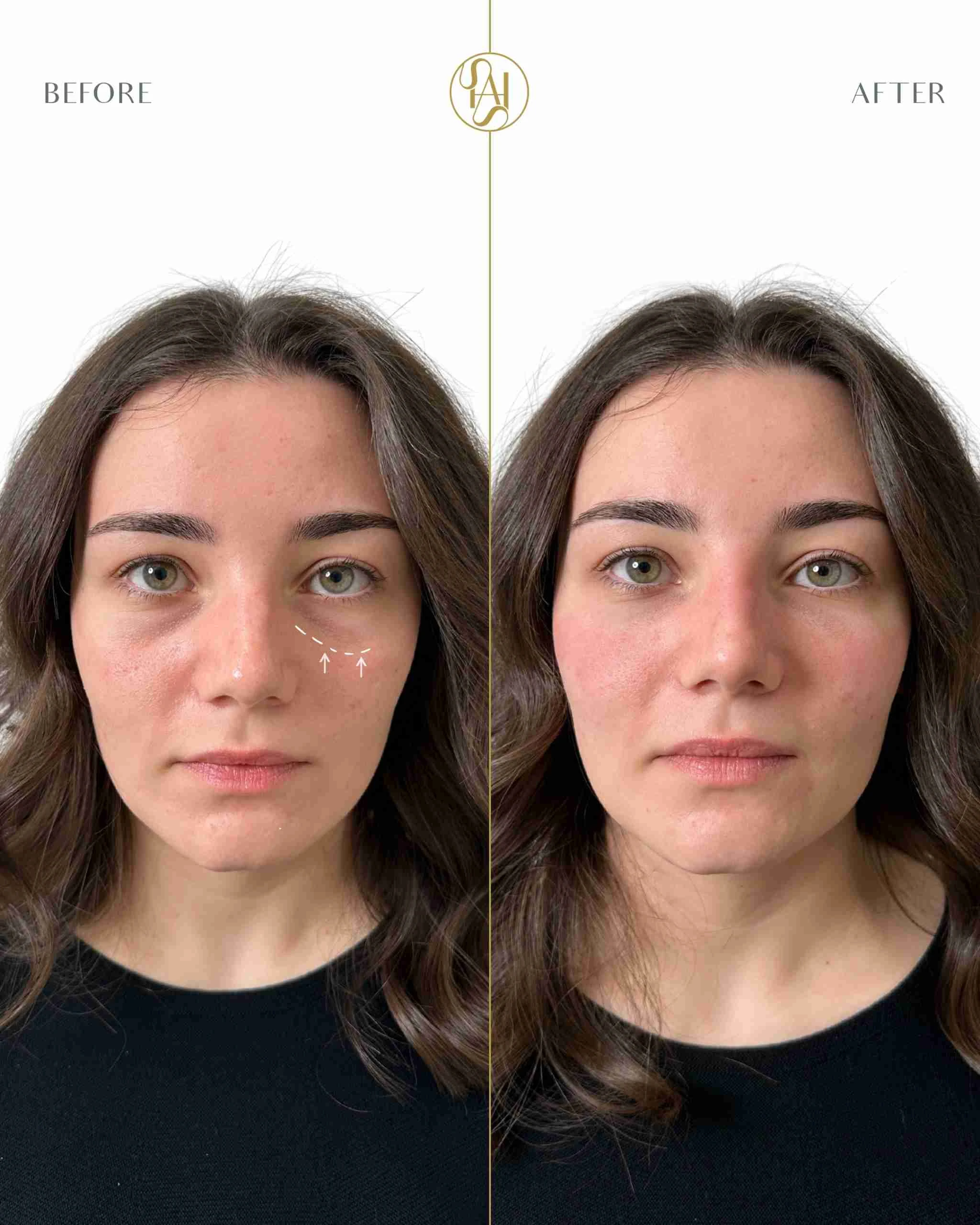
Who should not have it
Filler is not the answer for everyone. People with very thin skin, prominent lower eyelid fat bags or a lot of loose skin are often better served by lower eyelid surgery (blepharoplasty), which deals with the structure directly. Some medical conditions can also rule filler out, which is why a full medical history matters.
Questions to ask before treatment
- Is the injector a doctor or another medically qualified professional?
- Which filler will be used, and is it hyaluronic acid?
- Is hyaluronidase kept on site?
- Will a cannula or a needle be used, and why?
- Who do I contact if there is a problem out of hours?
A practitioner who answers all five clearly, and who is willing to tell you filler is not right for you, is the one to trust.